Welcome to the October 2026 Special Edition of Athens Travel Pulse.
This month, we break down and present the Private Transfers in Greece Whitepaper, a comprehensive industry study commissioned by The Greek Taxi. Every statistic, market analysis, and conclusion in this study is powered by BizList.
BizList operates as the primary database for Greek corporate intelligence, extracting raw data directly from the General Commercial Registry, official balance sheets, and public state records.
For travel designers vetting ground partners and investors conducting strict due diligence, assumptions are a liability. BizList removes the guesswork, allowing professionals to search and verify local operators by activity code, operating region, and executive management.
Armed with this elite level intelligence, our whitepaper grants discerning trip curators and strategic stakeholders absolute visibility into the Greek ground transportation sector. Flawless mobility is the absolute core of the premium travel experience, and mastering the hidden mechanics of this market is non-negotiable when catering to the discerning traveller.
Here is your exclusive October breakdown of the industry’s true operational challenges, shifting regulatory frameworks, and untapped strategic opportunities.

The State of Ground Transportation Logistics in Greece
The Greek private transportation landscape operates under a fragmented licensing framework featuring four distinct vehicle categories:
- Taxi sedans equipped with a taximeter and regulated by the state.
- Taxi mini vans (6-8 passengers) operating with a taximeter under state regulation.
- Special hire taxis mini vans (6-8 passengers) operating without a taximeter under state regulation.
- Black cars (sedans and mini vans) functioning as private hire vehicles with a driver operated by private businesses.
While taxi licenses represent a strictly capped market with 13.589 licenses in Athens & Piraeus alone, each license corresponds to exactly one vehicle. In stark contrast, private hire businesses face no quantitative vehicle limits. A single business license for a black car operation can correspond to an unlimited fleet size. The General Commercial Registry shows 585 to 1.779 businesses with private hire as their primary activity, alongside 3.516 to 7.051 businesses declaring it as a secondary activity. Reflecting this massive operational footprint, the Deputy Minister of Infrastructure and Transport reported to Parliament on March 23, 2026, that private hire operations employ roughly 25.000 workers.
Tourism Demand, Annual Arrivals Surge & Operational Challenges
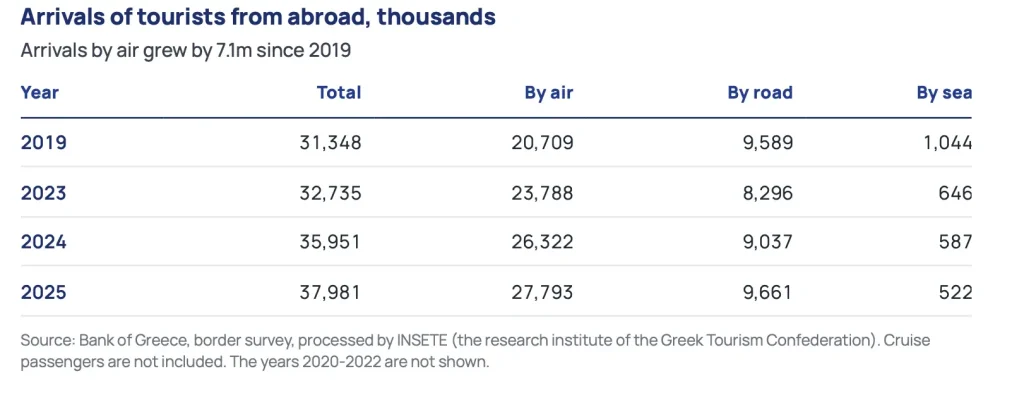
Greece is experiencing unprecedented influxes of travelers, with total airport passengers reaching 83.3 million in 2025 alongside 8.42 million cruise passengers. The 83.3 million airport passenger metric counts every traveler at every arrival and departure, including domestic flights. The 27.8 million arrivals from abroad by air in 2025 translate to approximately 55.6 million passengers if each traveler also departs by air. That constitutes roughly two thirds of all airport passengers, with domestic flights by foreign visitors driving the numbers even higher.
Athens had 34 million passengers in 2025, which is 33% more than in 2019, while the 14 regional airports of Fraport handled 37.1 million passengers, marking a 23% increase. Naxos had the largest increase since 2019 at 156%, originating from a small base. Next are Paros at 65%, Milos at 58%, Corfu at 41%, and Chania at 39%. Mykonos and Santorini are only 4% and 5% above their 2019 figures. The cruise ports handled 8.42 million passengers, reflecting a 52% increase compared to 2019. At the Fraport airports, 78.9% of passengers flew from or to another country. The largest markets were the United Kingdom with 7.3 million passengers, Germany with 5.5 million, and Italy with 2.4 million.
Foreign arrivals by air have surged by 34% since 2019. However, this dramatic increase in foot traffic is not yielding proportional growth in overnight stays, which grew by a mere 0.3% over the same period. This means more people are transiting through our logistics networks faster, demanding frictionless ground transportation.

The Financial Outlook
Eurostat data reveals that the combined taxi and private hire sector comprised 28.809 businesses and employed 36.620 individuals in 2024, generating a declared turnover of €824 million. This marks a significant recovery from the €302 million turnover during the 2020 pandemic and surpasses the €450 million recorded in 2015. Since these figures rely on declared tax forms, and neither Eurostat nor the Independent Authority for Public Revenue separates taxis from private hire under the NACE 49.32 activity code, isolating the exact financial health of black car operators requires deeper due diligence.
Regulatory Instability and Compliance Risks
Operating a premium fleet in Greece requires navigating severe regulatory volatility. Since 2012, rules governing private hire have shifted constantly, and since 2018, legislative changes targeting minimum hire durations and advance booking requirements have occurred almost annually.
Unlike other European jurisdictions that cap fleet sizes, Greece regulates private hire exclusively through operating conditions. A 2023 ruling by the Court of Justice of the European Union in case C 50/21 determined that capping private hire vehicles to protect taxi viability is a purely economic aim and legally unjustified. Furthermore, the European Commission explicitly noted in Communication 2022/C 62/01 that private hire vehicles should not be forced to return to their operator premises after each service, and flagged minimum hire durations and prices as restrictions requiring strict justification.
Despite European guidelines, the Greek state enforces rigid operating parameters. The minimum hire duration spans 2 hours from April to October across the mainland, Crete, and Evia, extending to 3 hours during winter. On other islands, minimum durations are 30 minutes in summer and 3 hours in winter. Nationwide advance booking mandates dictate a 30 minute minimum notice before passenger pickup. The financial penalties for non compliance are severe, with fines starting at €6000 for operating without a contract or advance booking, escalating to €10.000 for a second offense within a year.
Surviving the Greek Private Transfers Industry
Can an independent ground transportation provider thrive in Greece? Success requires balancing intense summer demand against crushing seasonality. During 2025, Mykonos airport handled 57 times more passengers in July than in January, yet fleet maintenance, insurance, and financing costs remain fixed year round. Furthermore, upcoming environmental mandates dictate that all new private hire vehicles in Attica and Thessaloniki must feature zero emissions by 2027. This necessitates massive capital expenditure for EV fleet upgrades and charging infrastructure.
Beyond environmental mandates, operators face a constantly changing legal framework that creates significant business uncertainty. Since 2012, regulations governing private hire vehicles have shifted repeatedly, with amendments introduced almost every year since 2018. Independent businesses must continuously adapt to restrictive operating conditions, including the rigid 30 minute advance booking mandate and strict minimum hire durations that vary drastically between the mainland and the islands. The financial risks for administrative errors are severe, as operating without a properly recorded contract or advance booking triggers immediate fines.
This regulatory volatility is compounded by a profound structural imbalance in the market. While the state strictly caps taxi licenses at approximately 28000 nationwide, private hire businesses face no quantitative vehicle limits. This absence of a cap leads to an unchecked expansion of black car fleets, exponentially intensifying competition during the short summer window. Meanwhile, the sector must absorb the pressures of rising taxation policies, such as the newly enforced minimum presumed income for sole proprietorships and the mandatory implementation of POS terminals to monitor all transactions.
When you combine these local structural barriers with global macroeconomic challenges, geopolitical uncertainty, and shifting travel behaviors, navigating the Greek mobility sector demands exceptional operational resilience.
At The Greek Taxi, we offset these operational hurdles by maintaining our own exclusive hybrid Mercedes-Benz fleet and managing all logistics in-house. We absorb the regulatory complexity, the capital risks, and the seasonal volatility so we can deliver flawless experiences to all our clients.
The Soul of the Moving City
Athens is moving faster than ever, yet it still knows how to take its time. We invite you to join us on the journey, knowing that whatever the road brings, you are in the hands of those who call this city home.
Safe travels, and we look forward to seeing you in our rearview mirror.
Stay Ahead of the Curve
The Athenian travel landscape moves fast, but you can move faster. Follow our monthly Athens Travel Pulse for ground truth on logistics, infrastructure updates, and industry insights delivered directly to you.
Brought to you by the logistics and ground transport specialists at The Greek Taxi.
The Greek version of the Private Transfers in Greece Whitepaper powered by Bizlist can be found here.
The Engish version of the Private Transfers in Greece Whitepaper powered by Bizlist can be found here.




0 Comments